
My Journey from and back to Foehrenwald.
Updated: Sep 17, 2025
My parents, Max Hellman and Fancia Silberschein were born in Zaleszcyky Poland in the early 1920s. They both miraculously survived the Holocaust. My father never understood how he survived those terrible years basically by hiding in the forests– he saw it as luck/fate. My mother and her parents and brother were hidden by a Ukrainian/Polish woman. My mother was introduced to the neighbors as a niece – she was blond, blue eyed and knew enough Christian prayers and customs to pass. Although she was in constant fear, her bravery kept her family alive.
That area of Poland was liberated in Spring of 1944 by the Russian army. They returned to Zalescyky and the neighboring villages to look for family survivors. There were none. Max and Fancia were the few of that age that had survived, and although it wasn't a love match, they decided to throw their lots in life together and move forward.
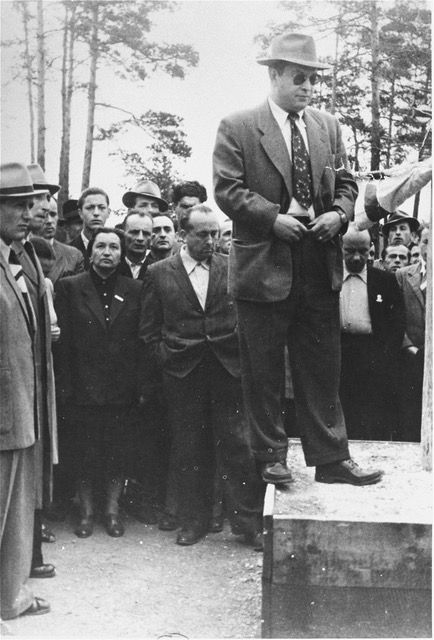
There was no future for them in blood-soaked Poland. In the Fall of 1945 they arrived at DP Camp Foehrenwald, in the US sector of occupied Germany. They were assigned a room in No 2 Florida Street. Life in the Camp gave them a chance to regain their strength and renew their lives after the horrors they suffered. My father had reason to believe that he would never be able to have children, so when I was born in June 1946 it was nothing short of a miracle for them. With my birth, they were now a family.
My parents wanted to immigrate to Israel, but because of my father's health condition and his need for ongoing treatment, we migrated to the United States in September 1949. When we arrived in Los Angeles, even though I was just a child, I was the one who learned English quickly and thus took on the adult role of guiding my parents through the labyrinth of this new strange land. In many ways, my only unadulterated childhood years were in Foehrenwald.
I never felt that I belonged in the United States. I knew that I was different – not just a Jew in a Christian country, but a child of Holocaust survivors. I was proud of my parents but yet embarrassed by their European accents. I felt both the subtle and overt anti-semitism all around me. I listened through the thin walls of our apartment to my parents and their survivor friends talk about their Holocaust ordeals as I lay in my bed in the next room. I knew at a young age that I personally had to do something significant to insure “never again” – so after we both graduated from college my husband Tony and I immigrated to Israel in 1969.
Over the years I worked intensively with new immigrants. I also advocated for women’s rights and marched for the promotion of a negotiated peace between Israel and her neighbors. We raised two children and now have four grandchildren
For my 70th birthday, I returned to my place of origin: Foehrenwald, a town now called Waldram. I was overwhelmed to meet the group of local German citizens who were creating a volunteer-led museum, the Badehaus Place of Remembrance, to honor this very past that had been eclipsed for so long. There are many memorials to honor those who were murdered in the Holocaust. Now there was finally a place to tell the heroic story of those, like my parents, who had survived, who miraculously came out of the ashes, created family units and renewed their lives.


Comments