
Our Father, Saul Sorrin

contributed by Len Sorrin, Robert Sorrin, Ellen Sorrin and Family.
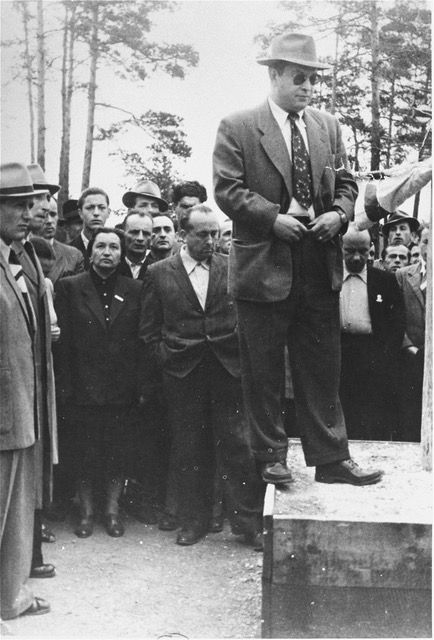
Between 1946 and 1950, our father, Saul Sorrin, was UNRRA and then IRO Area Director of several DP camps in the Munich area, starting with Neu Freimann. He took on responsibility for Foehrenwald under the IRO. Dad spoke often of the almost unimaginable zeal of the DP survivor community to climb out of the horrors and rebuild their lives, their families and their culture. Everything they lost would be created anew. Some emigrated to those nations that would have them, hindered by anti-semitic immigration policies. Some stayed. Others went to Palestine, seeking to wrap themselves in the Jewish homeland they never had. Some of those emigres left with forged transit papers water-aged on the radiator in Dad’s office.
These experiences left Dad, like many others, changed forever. It transformed his life, the rest of which was spent in Jewish community relations, interfaith relations and civil rights. It caused him to possess, in the words of a very close family friend, “the most acute sense of right and wrong I have ever seen.”
This is perhaps the most evocative picture taken of Dad during those years. [above]
It was taken on May 15, 1948 in Foehrenwald. Dad is about to make a few remarks and raise the flag of the new nation of Israel, established that day, over the camp.
Years later, in 1994, Dad was interviewed at the USHMM about his experiences. The interview took place a mere 8 months before his death. The interview is archived at the Museum. Dad concluded the interview with the following observations about the DP community and the indispensable role it has played over the years in communicating the horrors of the Holocaust to the rest of the world.
"Well, I want to say a few words about the meaning, the significance for the Jewish
community, for Jewish history, of the whole DP experience. We are commanded to
communicate to the world what it is Jews experienced during this period of the
Holocaust. And the principal vehicle for that is the DP survivor community. Both
those survivors who survived the horrors, and they are a smaller number of the
concentration camps and the extermination camps, and those who survived by
fleeing into the woods, or fighting in the Soviet army, or living as refugees within the
Soviet Union. Without them, the world would not know anything at all about these
experiences. So I think, to the degree that we are commanded to tell the story and
retell it to generations which follow us, they serve this vital purpose. They are also an
indication of the vitality, the will to life, and to survival of the Jewish community,
both the survivors and the rest of us, who face formidable challenges to our survival.
These people were so grimly determined. It used to seem to me that if I had children,
I would say to them maybe I don't want them to be Jewish. Who needs that kind of
threat hanging over our lives? Yet, these people produced children, recreated their
families. We could not provide the beds, to birth these children that they needed. A
great will, a great desire, even to be found in the so-called black market, to provide
the means for survival and the means to support whatever families they would create.
They were really the phoenix rising out of the ashes of European Jewry. And they
have gone on to produce great things, both here and in Israel. All over the United
States, I know Jews who are survivors and are wonderfully contributing members of
society. There is so much talk about immigrants coming in, and the threats which are
posed by immigrants to the American economy and the American people. The Jews
of Europe who came here did nothing but produce life and energy and things that we
need in order to maintain the richness of our society. So it's an important thing. We
have to be truly thankful to these people and understanding of who they were, what
motivated them, and the dangers which they lived through. Even after the Holocaust
appeared to have ended came this period. We know so much about the sufferings, but
now we ought to know more about the work which they did, the sacrifices which
they have made."
-Saul Sorrin | from 1994 USHMM Interview


Comments